From Neolithic communities to amphora merchants to modern summer arrivals, layers of human history remain visible across Kassandra and in the village above the bay.
5300-4500 BCE · Late Neolithic
Early settled communities
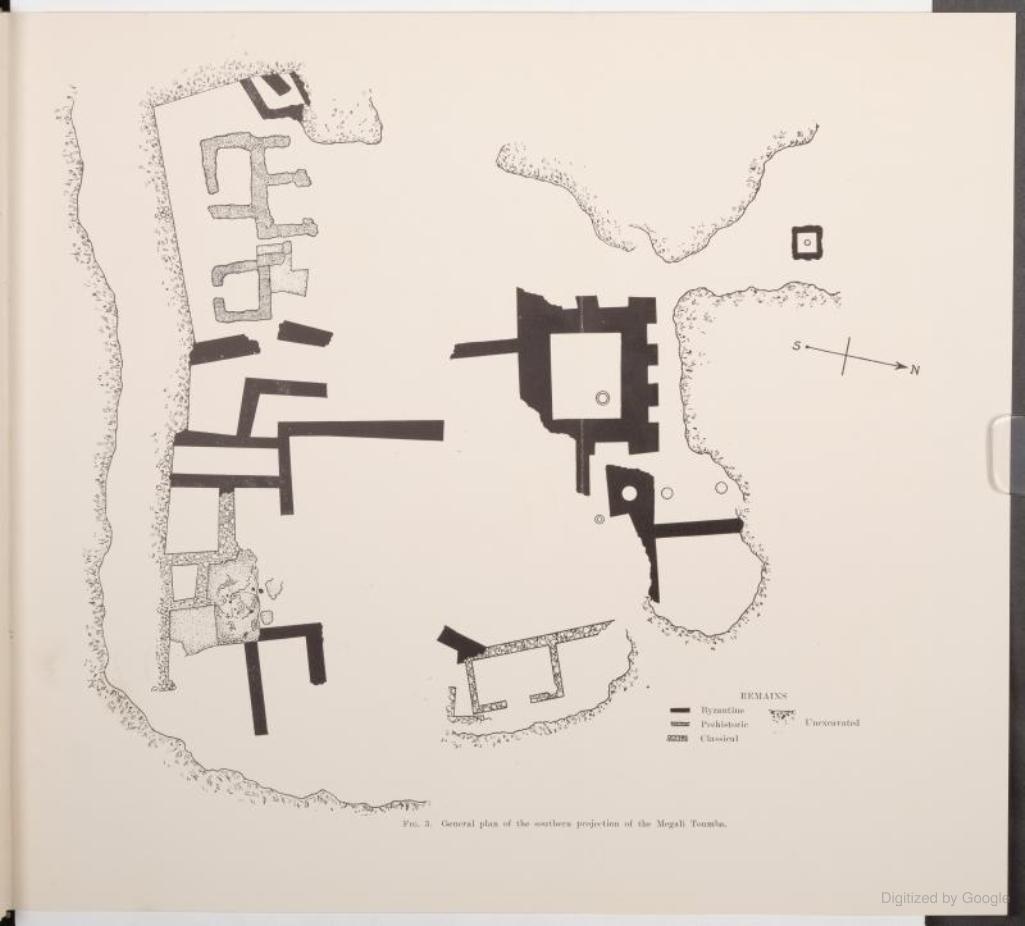
By the Late Neolithic, settled communities were established in Halkidiki. At Olynthus, north of Kassandra, excavations have revealed houses, pottery, stone tools, figurines, and weaving equipment dating to roughly 5300-4500 BCE, evidence of an established farming world in the region.
General plan of the southern projection of the Megali Toumba at Olynthus, a site in Halkidiki between the Kassandra and Sithonia peninsulas, not on Kassandra itself. From G. E. Mylonas, Excavations at Olynthus, Part I: The Neolithic Settlement (Johns Hopkins University Studies in Archaeology No. 6, ed. D. M. Robinson; Baltimore: The Johns Hopkins Press / London: Humphrey Milford / Oxford University Press, 1929).
8th century BCE
Ancient Mende & the Eretrian colonies
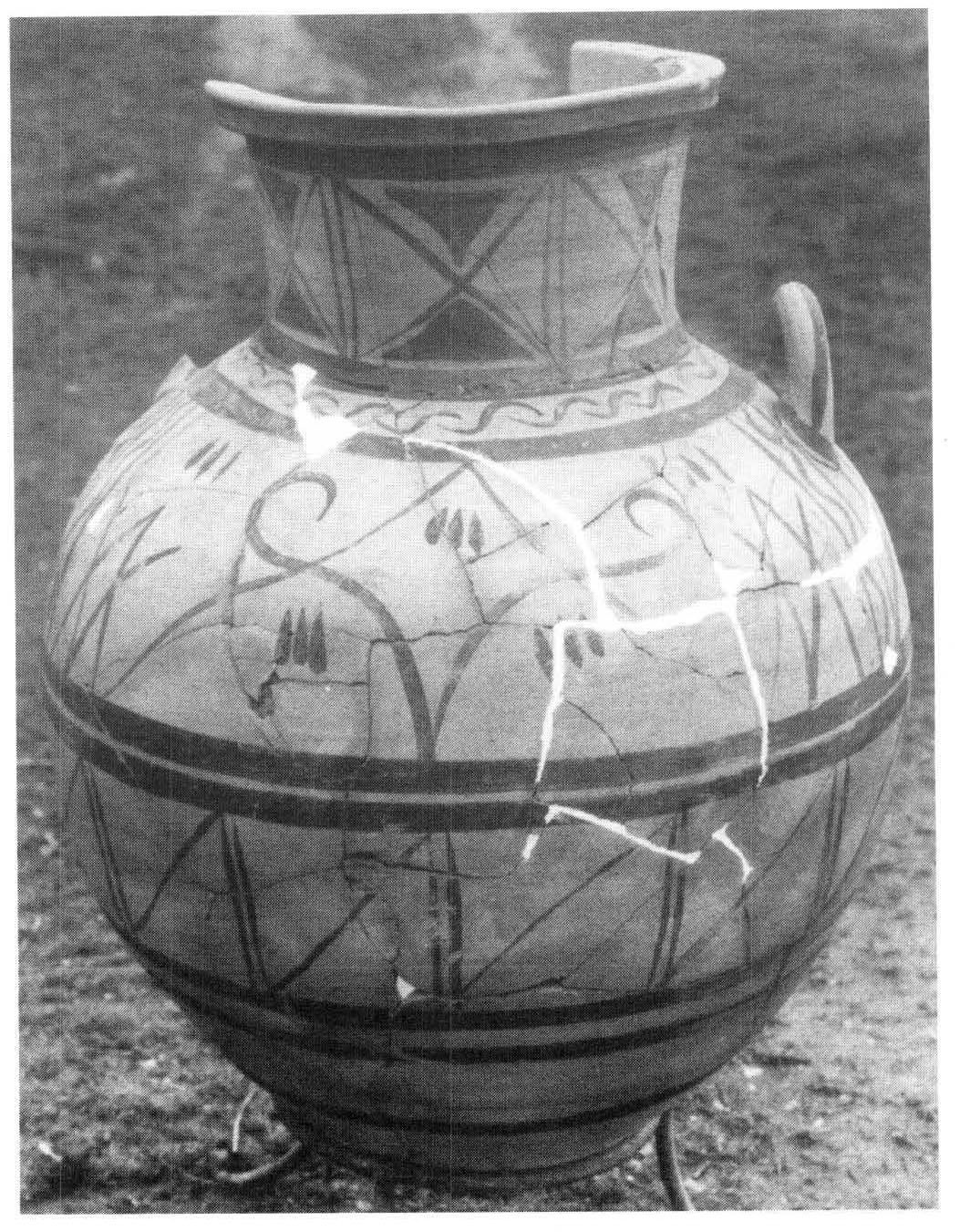
Eretrian settlers established Mende as one of the important cities of Pallene, the ancient name of the Kassandra peninsula. By the Archaic and Classical periods, Mende was renowned for its wine, which was exported widely in locally produced transport amphorae.
Pithamphora with floral motifs from the cemetery at Mende. From S. Moschonissioti, 'Vases du cimetière de Mendè,' in Recherches récentes sur le monde hellénistique (Publications du Centre Jean Bérard), available via OpenEdition Books: https://books.openedition.org/pcjb/661.
348 BCE
Macedonian rule
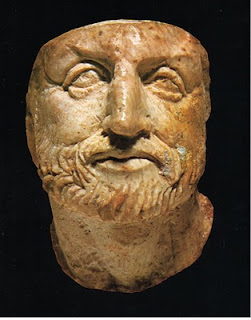
Philip II of Macedon destroys Olynthus in 348 BCE, breaking the power of the Chalcidian League and strengthening Macedonian control over Halkidiki. Mende was also destroyed or severely damaged during Philip's campaigns and subsequently declined as regional power shifted elsewhere.
Ivory portrait head identified as Philip II of Macedon, recovered from Tomb II of the Great Tumulus at Aigai (modern Vergina), the royal necropolis of the Macedonian kings.
Byzantine era
Monastic landscape
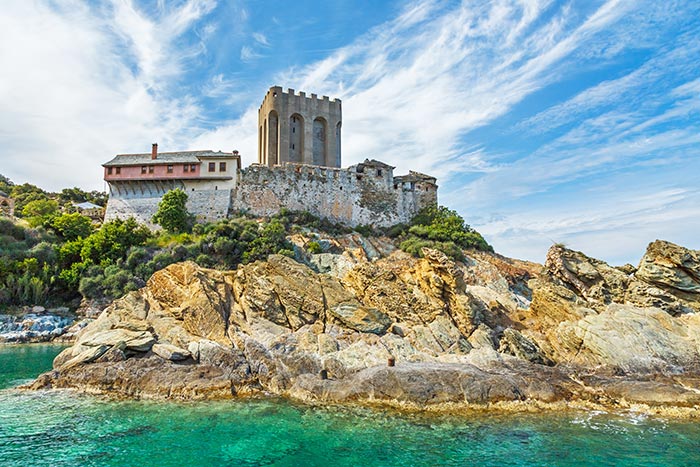
Mount Athos to the east develops into one of the great monastic centers of the Orthodox world. Across Halkidiki, agriculture, pastoralism, fishing, woodland use, and monastic estates shaped everyday life through the Byzantine and later Ottoman periods.
The Great Lavra (Megisti Lavra), founded in 963 CE by St. Athanasios the Athonite, the oldest and first-ranked of the twenty monasteries of Mount Athos.
1430-1821
Ottoman Kassandra
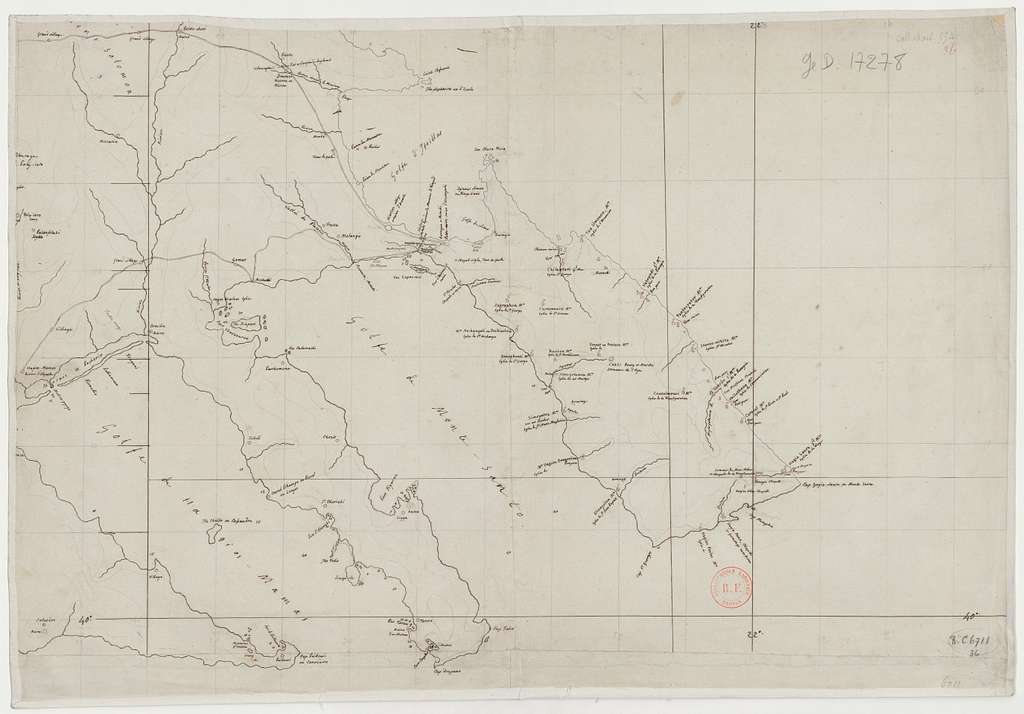
After the fall of Thessaloniki in 1430, Halkidiki passed under Ottoman rule. Kassandra's villages were organised around agriculture, livestock, timber, and fishing, with taxation and land arrangements that included monastic estates and, elsewhere in Halkidiki, the semi-autonomous mining communities of Mademochoria. Settlement remained concentrated inland and on the hillsides rather than on the open shore.
Eighteenth-century map of southeastern Chalkidiki, showing the peninsulas of Kassandra, Sithonia (Longos), and Mount Athos. Bibliothèque nationale de France, Department of Maps and Plans, 1780. Public domain.
1821 onward
Revolution, destruction & return
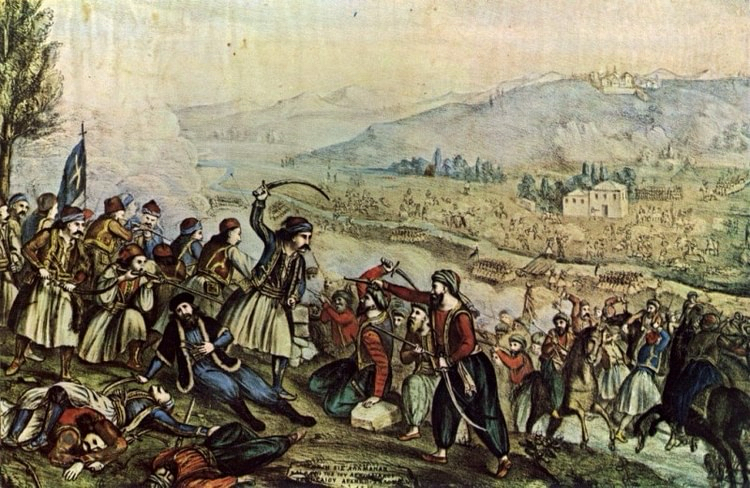
Kassandra became one of the principal centers of the 1821 uprising in Halkidiki. After months of resistance, Ottoman forces broke through the peninsula's defenses in November 1821 in the event remembered locally as the 'Destruction of Kassandra.' Settlements were burned, inhabitants were killed, captured, or displaced, and the peninsula suffered severe depopulation before communities gradually recovered during the decades that followed.
Scene from the Greek War of Independence (1821), from the series of folk lithographs commissioned by General Yannis Makriyannis and painted by Panagiotis Zografos (1836-1839) to illustrate Makriyannis' Memoirs.
1923
Population exchange
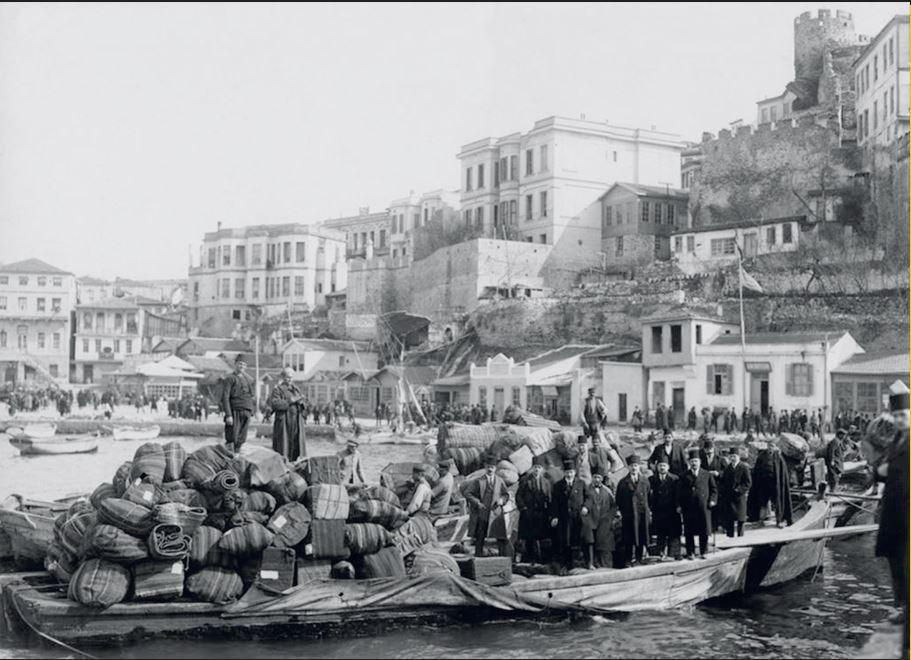
Following the Greco-Turkish War and the 1923 compulsory population exchange, refugees from Asia Minor and other former Ottoman territories were settled across Macedonia, including Halkidiki. Their arrival reshaped the region's settlement pattern and added new communities to the peninsula's social and cultural landscape.
Greek refugees from Asia Minor arriving by caïque at the port of Thessaloniki in the wake of the 1923 Convention Concerning the Exchange of Greek and Turkish Populations. Photographer unknown; widely reproduced from the interwar press archive (see Margaret21, 'Greek refugees from Smyrna arriving at Thessaloniki 1923': https://margaret21.com/2015/02/18/nation-swap-house-swap/greek-refugees-from-smyrna-arriving-at-thessaloniki-1923/).
1960s-today
The tourist coast
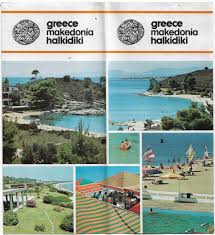
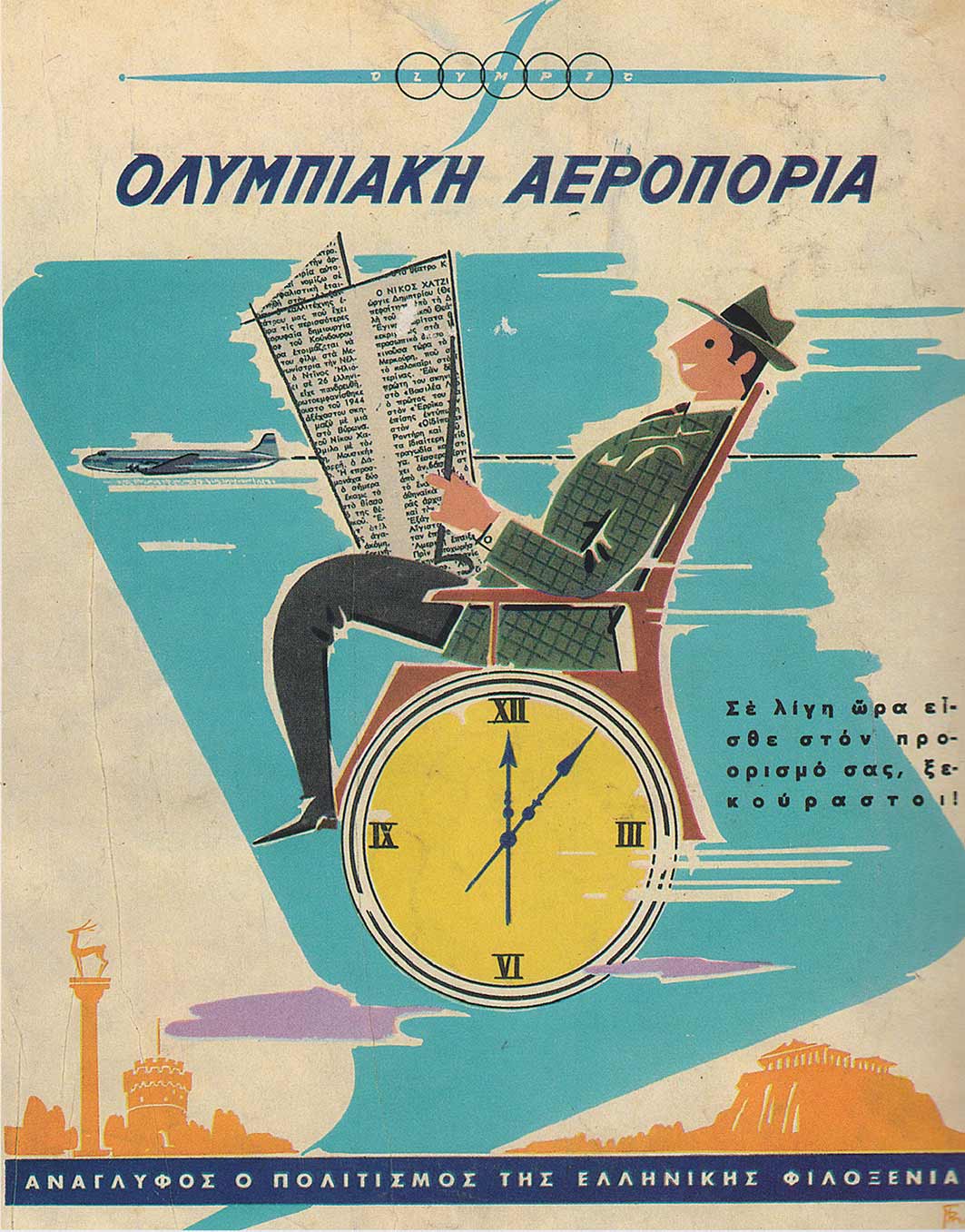
Improved roads and the rapid growth of Greek coastal tourism transformed Kassandra during the second half of the 20th century. Kriopigi expanded from its older hillside settlement into a major summer destination, while hotels, rented rooms, campsites, restaurants, and other tourism infrastructure spread toward the coast below. The change was rapid: published tourism data record 171 accommodation places in Kriopigi in 1976 and more than 2,200 by 1992. Tourism brought new livelihoods and development, while also increasing seasonal pressure on the shoreline and surrounding ecosystems.
Left: fold-out tourism brochure for Macedonia / Halkidiki issued by the Greek National Tourism Organisation (EOT), c. 1970s. Right: Olympic Airways (Ολυμπιακή Αεροπορία) print advertisement, c. 1960s, 'In a short while you will be at your destination, rested!', emblematic of the jet-age opening of northern Greece to mass tourism.