Snorkel Journey
What will you discover as you swim farther from shore?
Kriopigi has no famous dive sites. It has something better: you can walk in off the sand and watch the ecosystem change beneath you. Read this as one continuous swim, from dry sand to open blue.
Zone 1
The Shoreline
Before your mask even goes on
The swim starts on dry sand. Walk the strand line slowly and the beach stops looking empty.
Look for


Tiny tip
Lift only with your eyes. Leave every shell, crab and flower where you found it.
Zone 2
The First Meter
Water to your knees
The moment you step in, things become alive. Stand still for a minute and the shallows fill back in around your ankles.
Can you find…
- tiny mullet darting away from your shadow
 schools of sand smelt shimmering in the light
 juvenile sea bream in the warm edge water
- hermit crabs hauling borrowed shells
- transparent shrimp, visible only by their eyes
 sea cucumbers on the ripple crests
- swimming crabs buried to the eyes
 a little wrasse investigating your fins
What people say here
“There are way more fish here than I expected.” Almost everyone says it in the first two minutes.
Zone 3
Sandy Bottom
2–5 m below you
Now you are floating. This is where you start slowing down, the sand looks blank until you give it time.
Can you find…
 a salema school grazing
 a two-banded seabream
 a white seabream
 a striped seabream
 a painted comber sitting perfectly still
- a buried weever (look carefully, only the eyes show)
- a sea cucumber and the clean sand behind it
- a sand smelt shoal turning together
Zone 4
Rocky Patches
3–7 m, scattered blocks and reef
Every rock becomes interesting. Search the cracks rather than the open water.
Can you find…
 an octopus den
 a peacock wrasse in breeding colour
- a rainbow wrasse
 a five-spotted wrasse
 a dusky grouper holding its ground
 damselfish clouding above the reef
- a stone crusted with algae and encrusting sponge
- a nudibranch grazing a rock face
Look closely
Look for neat piles of empty shells outside a crack in the rocks. They often reveal an occupied octopus den.
Zone 5
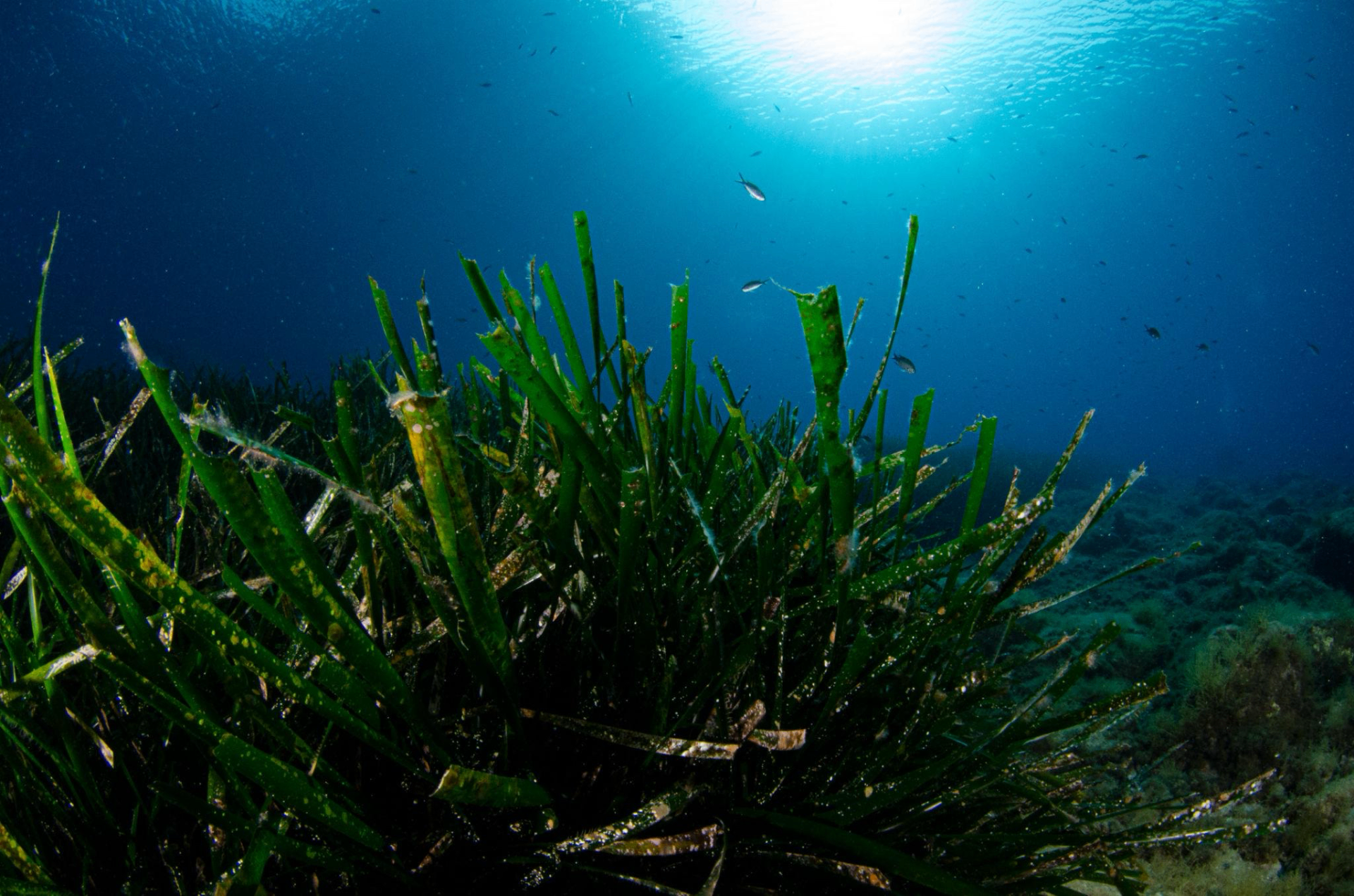
The Underwater Forest
Posidonia meadow, 5–12 m
Slow down. Stop kicking. Let the meadow come alive around you, nothing here rewards speed.
Can you find…


Look closely
Hover, do not swim. Thirty still seconds is worth more than thirty metres of kicking.
Zone 6
Blue Water
Beyond the meadow edge
You leave the meadow and everything suddenly becomes enormous. Sightings become rarer and far less predictable.
Can you find…


Before you go out
Always swim with a buddy, stay inside the swim area, and check the day's sea state before leaving the meadow behind.
Look Closely
Five things worth waiting for
Knowing a species' name is the easy part. These small observation challenges are what turn a swim into a field session.
Peacock wrasse
Symphodus tincaThe males flash electric green and blue through the spring.
Look closely
Their colours shift as they turn toward the sun.
Octopus
Octopus vulgarisOften invisible until it moves.
Look closely
Empty shell piles often reveal the entrance to its den.
Sea cucumber
Holothuria tubulosaSlow recycler of the seabed.
Look closely
You will often see neat strings of cleaned sand behind it.
Salema
Sarpa salpaOne of the few herbivorous fish in the Mediterranean.
Look closely
Watch them bite individual Posidonia leaves one after another.

Cuttlefish
Sepia officinalisMaster of camouflage.
Look closely
Stay still for thirty seconds and watch waves of colour travel across its skin.
Reward curiosity
Three levels of attention
Not a collection to complete. Three tiers of patience, most swimmers finish the first on their first morning, and the last is a matter of luck.
Careful Observer
For swimmers who stop moving and watch.
Lucky Day
Rare, unplannable, worth remembering.
Log what you saw
Your swim can become a record
Photograph anything you cannot name and upload it to iNaturalist, a free platform where naturalists help confirm identifications. Each verified photo turns a holiday sighting into an occurrence record for this stretch of coast.
Open iNaturalist →